The SMART Lab’s research is built on the intersection of energy and manufacturing technologies. We utilize both fundamental engineering disciplines and modern data-driven tools to connect sustainable manufacturing, advanced recycling, and energy conversion/storage.
Our work spans the fields of materials science, electrochemistry, thermal science and transport phenomena, mechanics, circularity, sensing and instrumentation, and AI-enabled computing.
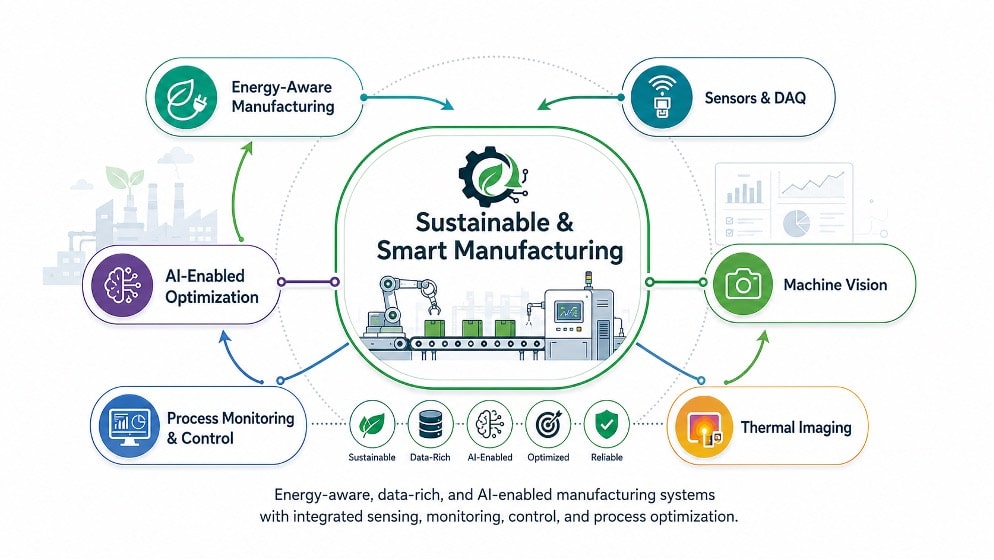
We develop energy-aware, data-rich, and AI-enabled manufacturing equipment and lines that builds on and extends prior work in machining, chatter detection, process stability, and real-time manufacturing diagnostics.
Our systems integrate sensing, data acquisition, machine vision, thermal imaging, process monitoring, control, and model-based optimization.
Our goal is to create manufacturing processes and machines that can
- measure their own state
- understand process variation
- recommend or implement corrective actions
- reduce energy use
- improve product quality
- support more reliable operation across variable conditions
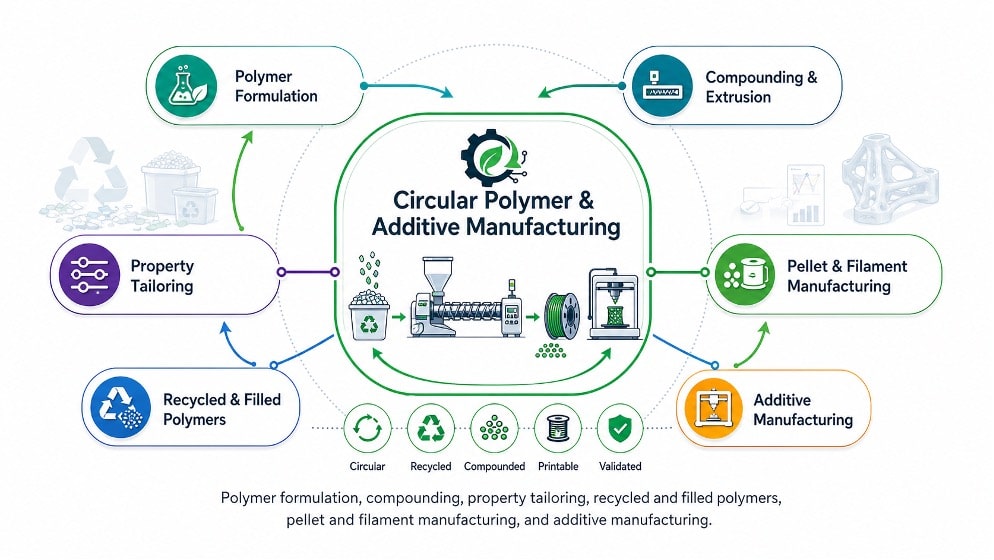
Our research in circular polymer manufacturing includes polymer formulation, compounding, property tailoring, recycled and filled polymers, pellet and filament manufacturing, extrusion, injection molding, and additive manufacturing.
One major focus is developing closed-loop polymer-processing workflows that convert virgin, recycled, and filler-modified feedstocks into validated materials and manufactured products. This work includes:
- compounding polymers with fillers and additives
- producing pellets and 3D-printing filaments
- studying feedstock variability
- monitoring filament quality
- linking processing conditions to mechanical, thermal, rheological, and printability performance
This research supports sustainable manufacturing, polymer recycling, and the development of higher-value materials from circular feedstocks.
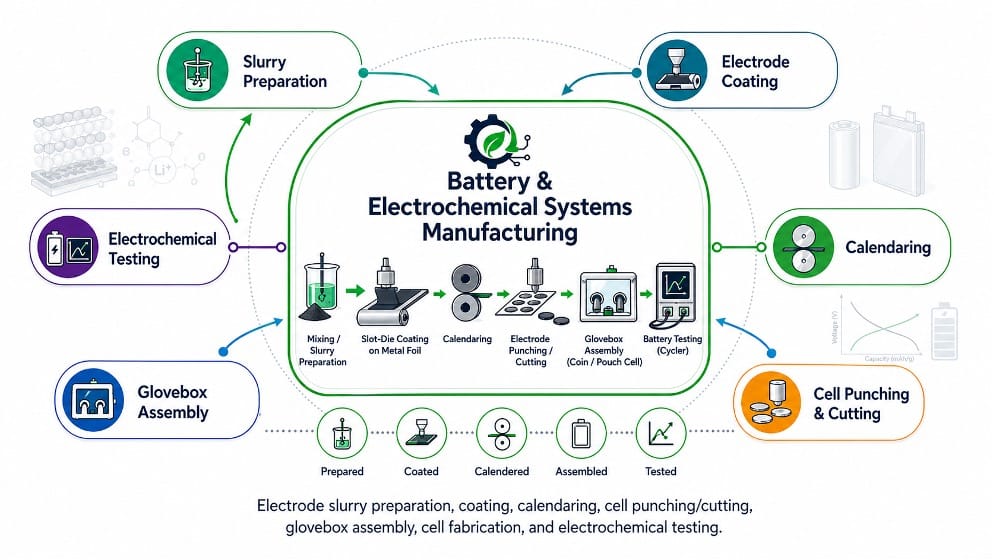
Our work in battery and electrochemical systems manufacturing connects materials synthesis, electrode processing, cell manufacturing, and performance validation.
The lab’s battery-manufacturing capability supports both fundamental process-structure-property studies and applied research on energy-storage technologies, safety, performance, and manufacturability.
Manufacturing capabilities:
- electrode slurry preparation
- coating
- calendaring
- cell punching and cutting
- glovebox assembly
- cell fabrication
- electrochemical testing
Research topics:
- lithium-ion battery materials
- electrode processing
- electrolyte-related studies
- cell assembly
- electrochemical characterization
- structural energy systems
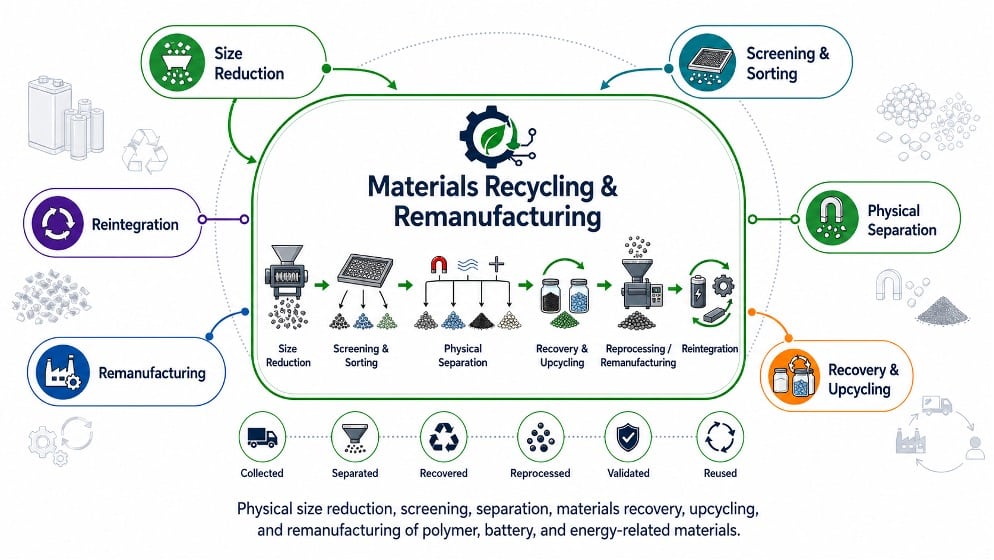
Our focus on materials recycling, upcycling, recovery, and remanufacturing primarily involves polymer, battery, and energy-related materials. This research builds toward practical circular-economy solutions that recover valuable materials, reduce waste, and enable reintegration of recovered materials into manufacturing supply chains.
Research includes:
- physical size reduction
- screening
- separation
- electrode-material recovery
- electrolyte recovery
- pack-polymer recycling
- recycling-oriented materials development
Materials we work with:
- lithium-ion batteries
- polymers
- electric motors and magnets
- photovoltaic materials
- fuel cells
- printed circuit boards
- wind-turbine materials
- other complex end-of-life or industrial material streams

We develop concepts and testbeds for AI-enabled manufacturing machines and collaborative manufacturing lines.
This research focuses on embedding intelligence into machines through:
- sensing
- monitoring
- self-assessment
- adaptive decision support
- closed-loop process improvement
It also explores collaborative manufacturing systems where machines, humans, data, and models interact to improve productivity, quality, safety, and sustainability.
These ideas align with emerging directions in AI-assisted and AI-native manufacturing, including embodied intelligence in machines and collective intelligence across manufacturing lines, laboratories, factories, and supply networks.
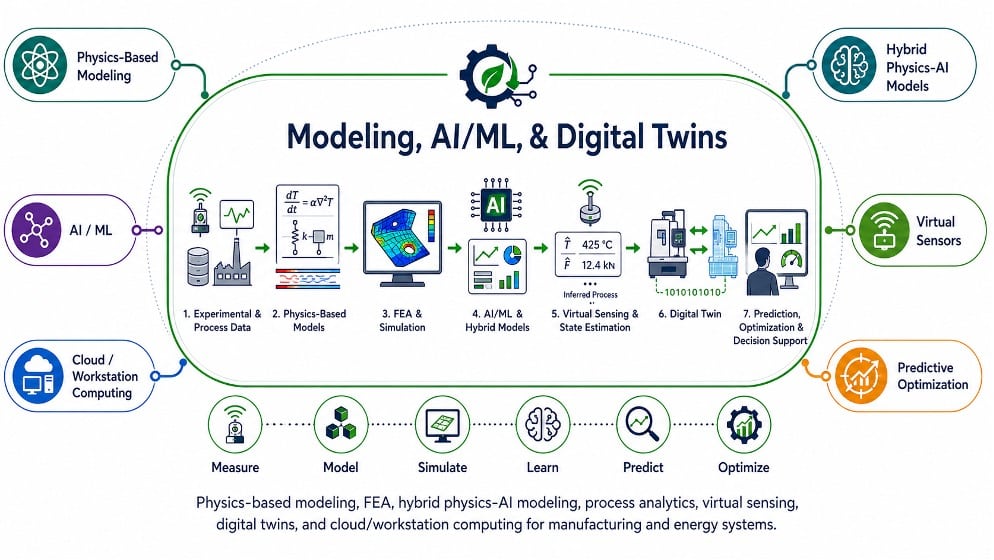
The lab develops physics-based models, finite element models, hybrid physics-AI models, process analytics, virtual sensors, and digital twins for manufacturing and energy systems.
These tools are used to connect experimental data, process physics, material behavior, and product performance.
A current emphasis is on physics-grounded and agentic digital twins for circular polymer manufacturing, where real-time sensing, machine data, material characterization, and AI/ML models are used to understand process behavior and support model-based optimization.
This research enables smarter experimentation, faster process development, improved quality prediction, and transferable learning from lab-scale platforms to larger manufacturing systems.

Our work utilizes mechanical, thermal, chemical, electrochemical, rheological, tribological, morphological, and process-quality characterization to validate materials and manufactured products.
Characterization is not treated as a separate activity, but as a key part of the lab’s research loop: feedstock preparation, processing, sensing, modeling, product fabrication, testing, and feedback for process improvement.
This capability supports studies of recycled polymers, filled composites, battery electrodes, electrochemical cells, coatings, printed parts, tribological surfaces, and recovered materials.
The goal is to connect processing history and material structure to performance, reliability, manufacturability, and sustainability.